
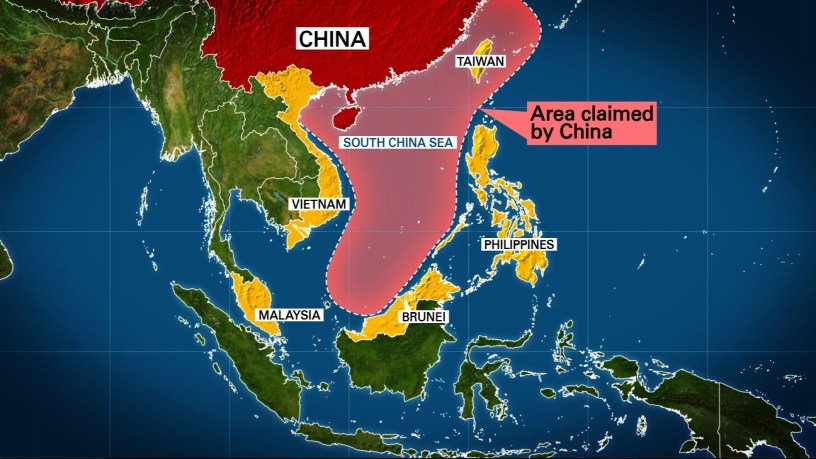
The South China Sea dispute is as complex as it is old. Indeed, although the conflict has attracted a lot of attention over the last few years, its origin goes back to the 1970’s. To sum up the dispute, one could say that it is a matter of different countries fighting over territories in the South China Sea. Although that overview is not inaccurate, it is incomplete to say the least.
Who is involved?
The dispute is between all the states that have access to the South China Sea: Malaysia, Brunei, the Philippines, Vietnam, Taiwan, Indonesia and China. The main problem, the one that has been dragging for decades, is that two or more of these states claim the same territories, each providing all kinds of historical and legal legitimacy to justify their claim. The Paracel and the Spratly Islands are at the centre of attention, being claimed by at least six governments. Experts expect these two islands chains to become the very centre of a conflict that might soon go beyond a diplomatic dispute.

Why is this zone getting so much attention?
There are several factors to take into account. The main one would be that the South China Sea is full of natural resources such as oil and gas. Estimations are generally between 11 and 22 billion barrels of oil and between 190 and 290 trillion cubic feet of natural gas. Needless to say, having sovereignty over territories in this sea would mean being able to exploit these resources, and therefore make considerable profit out of it. Additionally, the South China Sea is estimated to possess about 10% of the world’s fisheries.
Another factor is that this sea is one of the busiest in the world, being one of the main international trade routes. Controlling these waters could mean having control over the important maritime traffic taking place there. This explains why so many states are trying to gain sovereignty in this zone. It also explains why this conflict is of such high interest around the world as well, and especially for the United States. Important profit is at stake and depending on the relations with the state controlling the area, the gains or losses could be enormous.
What is concretely happening?
So far, the dispute has remained mostly diplomatic. However, as China is getting more and more assertive, concerns are growing that things might escalate very quickly. Indeed, China’s military will keep getting stronger and one of its main focuses is getting back the sovereignty over the South China Sea as Beijing views it as a long-lost Chinese territory. To that effect, China has drawn what they call the “nine-dash line” and claim the enormous area it includes, which is a huge source of controversy. Recently China has been increasingly deploying its military in the zone including on the Paracel and Spratly Islands, despite the protests of the other concerned states. In addition to that, China has been both increasing the surface of existing islands and creating artificial ones.
What actions have been taken so far?
In July 2016, the Permanent Court of Arbitration at The Hague, issued that China had “no historic rights” over the claimed sea, ruling in favour of the Philippines. Beijing rejected that decision by refusing to recognise the tribunal’s authority, therefore not recognising any binding force in the decision.
Several states, including the Philippines and Vietnam, have recently agreed to try and negotiate with China to avoid an open conflict. However, the US having important economic and political interests in the zone, are now viewed as part of the conflict. Indeed, Washington has been openly defying Beijing’s position and claims for two main reasons: the first one is to protect its economic interests, and the second one is because of its alliances with some Southeast Asian countries -including a defence treaty with the Philippines. Many experts consider that, should an armed conflict occur, the US are very likely to be heavily involved, as they may be one of the very few countries able to rival China in terms of military force.
Sources: Council on Foreign Relations, South China Morning Post, CNN, The Diplomat
 International Affairs